

Reading time: 4 min
What you need to know
- Hasbro now sells three pay-to-play extensions for its classic board game, introducing mechanics like buying the bank and profiting from jail – all for about $10 per pack.
- Monopoly Go! generated roughly $1.58 billion in 2024 alone, making the mobile spin-off more profitable than the physical game and transforming Monopoly into a high-stakes digital ecosystem.
- Elizabeth Magie’s original 1904 design was a protest against land monopolies. Today’s version has been stripped of that message and rebuilt around recurring revenue – a 90-year drift few publishers would dare to match.
Three new packs, one old promise
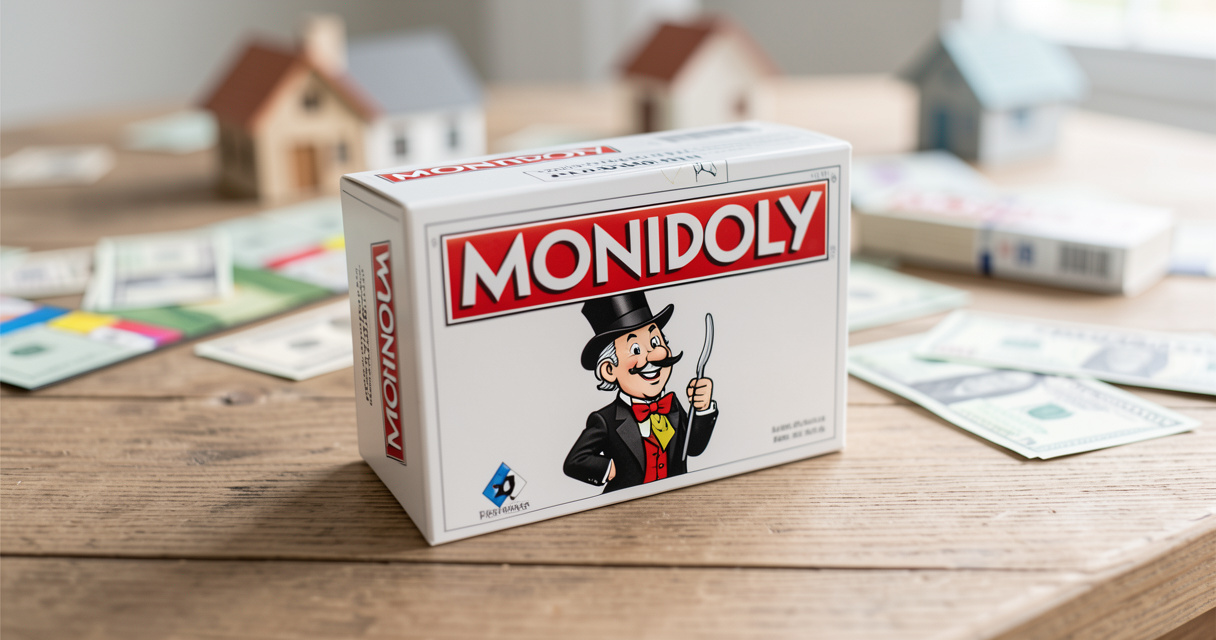
Let us be honest. The Monopoly you remember – the one your parents pulled out on rainy afternoons, the one that ended in arguments over who owned Boardwalk – is no longer the product Hasbro wants to sell. What is on the shelf in mid-2026 is something different: a base game plus three slim booster boxes. “Free Parking Jackpot,” “Go to Jail,” and “Buy Everything.” Each retails for about $10 and requires a standard Monopoly set to function. That sounds like optional fun. It is not.
If you strip away the noise, these packs are a deliberate lever. They shorten playtime, introduce random jackpots, and – most tellingly – let players purchase the bank itself. The “Buy Everything” extension includes a mechanism called the “Sale Vault” that makes almost anything tradeable: Go, Jail, even the Banker’s role. A review video from late 2025 showed a player buying the bank with a single card. That is not a house rule. That is a designed outcome.
I have very little patience for the argument that these are just “fun add-ons.” They are not neutral. Hasbro’s own press release, dated January 7, 2025, frames them as a way to “enrich the experience” and “dynamise” gameplay. The real question is not whether they add excitement. It is whether a game that now teaches children to bribe guards and purchase public institutions serves any educational purpose beyond conditioning them for a world where everything has a price.
A 90-year facelift – but the rules stay the same
At the same time, Hasbro overhauled the visual identity of Monopoly for its 90th anniversary. The board is cleaner, the colours are sharper, the money is redesigned, and the box includes plastic inserts to speed up setup. Company spokespeople said the updates were “ergonomic” and made games “more dynamic.” That is where things get interesting.
Most people get this wrong: the rulebook has not changed. The classic mechanisms – passing Go, buying properties, paying rent, drawing Chance and Community Chest cards – all remain exactly as they were in the 1930s. But the 2025 edition formalises several “house rules” that players had invented over decades. The most notable: all fines now go to the Free Parking space, which is then awarded as a lottery. That was never an official rule before 2025. Now it is printed in the manual.
This is not complicated, but it is demanding. By monetising informal variants, Hasbro effectively reclaims control over how people play. The company no longer hopes you will adopt house rules – it instructs you to. And if you want to go further, you buy the booster packs. The logic is identical to video-game DLC: sell the base once, then sell the additions repeatedly.
From protest tool to cash register
The irony of Monopoly’s commercial arc is almost too neat to be true. Elizabeth Magie patented her Landlord’s Game in 1904 to demonstrate the harm caused by land monopolies. She included two rule sets: one where wealth was redistributed (the “Prosperity” version) and one where a single player crushed everyone (the “Monopolist” version). Her hope was that families would see the difference and support Henry George’s single-tax movement.
Charles Darrow, an unemployed salesman, copied a modified version of Magie’s game during the Great Depression. Parker Brothers bought both Darrow’s product and Magie’s patent – Magie received a flat $500, no royalties – then marketed Monopoly as an American success story. Darrow became the inventor. Magie’s name disappeared from the box. The Prosperity rules vanished entirely. Only the zero-sum version remained.
This history matters because it shapes the present. What started as a warning has become a manual. And now, almost a century later, Hasbro has completed the transformation: Monopoly is no longer a board game. It is a diversified revenue stream.
Monopoly Go! – the real money spinner
If the physical game still feels familiar, the mobile version is not. Monopoly Go!, launched by Scopely in 2023, has become one of the highest-grossing mobile games of all time. In 2024, it generated about $1.58 billion. By the end of 2025, cumulative revenue had crossed $3 billion. These are numbers that rival blockbuster console titles. Most people get this wrong: Monopoly Go! is not a modest supplement to the board game. It is the financial engine that now drives the entire brand.
The mobile game uses a free-to-play model: players can progress without spending, but speeding up or unlocking premium content costs real money. In-game purchases, randomised loot-boxes, and limited-time events generate the lion’s share of revenue. For Hasbro, which earns licensing fees from Scopely, these recurring payments have become as significant as the profit margins on plastic houses and paper money.
That is where things get interesting for the physical product. The crowd that plays Monopoly Go! is younger, more accustomed to microtransactions, and expects constant dopamine triggers. The new board-game extensions – jackpots, bribes, bank purchases – mirror exactly those mobile mechanics. Hasbro is not chasing two separate audiences. It is unifying them under one economic logic.
What the expansions teach – and why it matters
I have been inside enough classrooms to know that teachers use Monopoly to explain basic economics: rent, interest, bankruptcy, taxation. Those lessons are already contentious. The new expansions go further. The “Go to Jail” pack includes cards that let you bribe guards, skip sentences, or earn rewards for being locked up. The official rulebook states the game is for ages 8 and up. An 8-year-old who learns that prison is a profit centre is not being taught critical thinking about justice – they are being conditioned to treat institutional boundaries as negotiable.
Educators and criminologists have raised similar concerns for years. A 2025 article from a general-news outlet quoted a teacher who said, “When a card lets you buy the bank, the message is different from paying rent.” That is an understatement. The entire moral architecture of a game that once demonstrated the costs of monopoly has been rewritten to normalise corruption.
Let us be honest: Hasbro is not thinking about pedagogy. It is thinking about shelf life. The classic Monopoly box sold once per generation. The new model – base game plus expansions – sells repeatedly to the same household. That is a textbook shift from product to service, even if the product still comes in a cardboard box.
The language of capitalism, domesticated
Monopoly has never been just a game. Its language has seeped into everyday speech: “Pass Go,” “Do not collect $200,” “Bank error in your favour.” French politicians and songwriters have used its vocabulary to comment on rent hikes and corporate bailouts. The board itself – Rue de la Paix, Champs-Élysées – functions as a symbolic map of value that children absorb before they understand real estate.
In the mid-2000s, Hasbro ran an online contest to choose cities for a national edition. The small town of Montcuq won overwhelmingly, but the final board omitted it. Hasbro later released a special Montcuq edition but never changed the main board. That episode is a small example of a large pattern: the publisher uses participation as marketing, then reserves the real decisions for itself.
The 2013 Monopoly Empire edition replaced streets with brands – Coca-Cola, McDonald’s, Intel. Players bought logos instead of properties. The direction was clear. The 2025 expansions complete the journey: from protest against land monopoly, to celebration of brand monopoly, to normalisation of institutional capture.
Legal strategy: protecting the asset
In 2022, the European Court of Justice ruled against Hasbro in a trademark case. The company had repeatedly filed the same Monopoly mark in a way that amounted to an abuse of the renewal system, effectively extending protection beyond what EU law intended. The ruling was covered by intellectual-property specialists throughout 2023.
The case is revealing. It shows that Hasbro treats Monopoly less as a game and more as a financial asset to be ring-fenced. The company’s investor communications routinely cite Monopoly as one of its “core brands.” Combined with the mobile revenue and the physical add-ons, the strategy is complete: lock down the intellectual property, maximise revenue per customer across every platform, and let the original message fade into the background.
Most people get this wrong. They think Monopoly is still a board game. It stopped being one years ago. It is now a monetisation framework, dressed in nostalgia and sold piece by piece.
The shelf, the screen, and what comes next
Go back to that parent and child standing in the aisle of a big-box store near Paris. The father sees a childhood memory. The child sees a mobile game with physical parts. The salesperson pitches “Buy Everything” as a cool new feature – you can literally purchase the bank.
The child asks a sharp question: “Is jail still a place where you lose turns, or is it now somewhere you win?” The answer, buried in the rules of the “Go to Jail” expansion, is both. It depends on which card you draw. That ambiguity is the product.
Monopoly has gone from a warning about monopoly power to a machine that normalises power abuse. From critique to apologia. From a single sale to a lifetime of add-on purchases. The irony would be funny if the game were not designed for children. But it is. And that is why we should stop calling it a game and start calling it what it is: a commercial system dressed in plastic houses.
If you are a parent, an educator, or just someone who values clarity over hype, ask yourself what you want a child to learn from a board game. Then check the instructions for Hasbro’s 2025 edition. I suspect you will find a mismatch.

Cuts through business noise to write about modern work, digital systems, and what actually helps people think, build, and operate better.